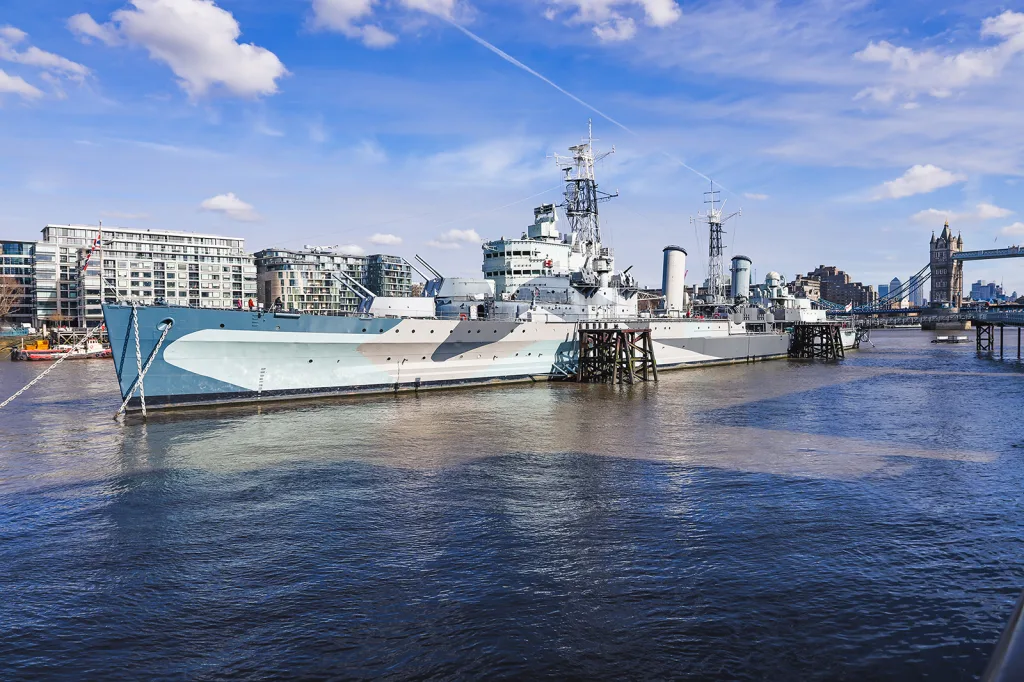


HMS Belfast is a Town-class light cruiser that was built for the Royal Navy. She is now permanently moored as a museum ship on the River Thames in London and is operated by the Imperial War Museum.
Construction of Belfast, the first ship in the Royal Navy to be named after the capital city of Northern Ireland and one of ten Town-class cruisers, began in December 1936. She was launched on Saint Patrick’s Day 1938. Commissioned in early August 1939 shortly before the outbreak of the Second World War, Belfast was initially part of the British naval blockade against Germany. In November 1939, Belfast triggered a German mine and, in spite of fears that she would be scrapped, spent more than two years undergoing extensive repairs. Belfast returned to action in November 1942 with improved firepower, radar equipment and armour. She saw action escorting Arctic convoys to the Soviet Union during 1943 and in December 1943 played an important role in the Battle of North Cape, assisting in the destruction of the German warship Scharnhorst. In June 1944, Belfast took part in Operation Overlord supporting the Normandy landings. In June 1945, she was redeployed to the Far East to join the British Pacific Fleet, arriving shortly before the end of the Second World War.
PTSG carried out testing of fall arrest equipment at HMS Belfast to ensure compliance with the latest industry standards and specifications (e.g. BS EN 795, BS 7883, BS6037 Parts 1 and 2, BS7883, LOLER 1998 and the EU work at Height Directive).
PTSG installs, tests and inspects and commissions the full range of fall protection equipment – fall arrest (which stops a fall after it happens) and fall restraint (which prevents a worker from reaching a fall hazard). This includes:
- Cable-based fall protection systems
- Eyebolt and single-point anchors
- Vertical fall protection systems
- Personal Protective Equipment (PPE)
- Guardrails and fixed ladders
- Abseil and anchorage, including rails and anchors