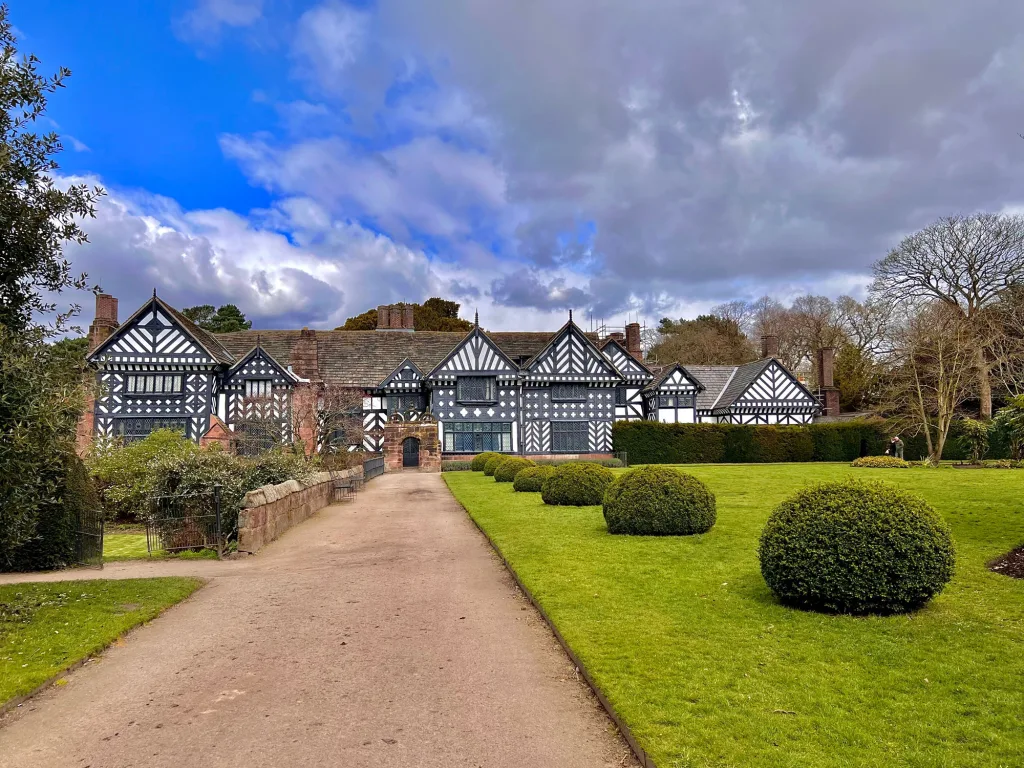


Speke Hall is a wood-framed wattle-and-daub Tudor manor house in Speke, Liverpool, England. It is one of the finest surviving examples of its kind. It is owned by the National Trust and is a Grade I listed building.
Construction of the current building began under Sir William Norris in 1530, though earlier buildings had been on the site, parts of which are incorporated into today’s structure.
During the turmoil of the Reformation the Norrises were Roman Catholics so the house incorporated a priest hole and a special observation hole built into a chimney in a bedroom to allow the occupant to see the approach to the house to warn the priest that people were coming. There is also an eavesdrop (a small open hole under the eaves of the house) which allowed a servant to listen in on the conversations of people awaiting admission at the original front door.
The gardens date from the 1850s. In the courtyard of the main building are two ancient yew trees, male and female, called ‘Adam’ and ‘Eve’. First recorded in correspondence dating to 1712, they are estimated to be at least 500 years old. Walks in the grounds give panoramic views over the Mersey estuary towards the Wirral Peninsula. Liverpool John Lennon Airport is adjacent to Speke Hall. The house received 224,913 visitors in 2019.
Since 2022, engineers from PTSG Electrical Services Ltd have carried out testing of the lightning protection system at Speke Hall. Once a lightning protection system is installed, it must be professionally tested at least once a year to ensure it is capable of conducting a potential lightning strike to a safe earthing point. This ensures compliance with the Electricity at Work Act 1989 and BS EN 62305.